










No greenwashing: setting and managing credible corporate climate objectives

From now on, posting "great" climate objectives on the home page of your website, or in your annual report, no longer convinces anyone. Customers, partners, investors, employees... all are now scrutinizing the reality of the actions behind the words. When it comes to the climate, trust can no longer be decreed: it can be proven, with figures to back it up. Each report must reflect a real commitment and a measurable impact, in line with ADEME's expectations and France's official environmental framework.
But how do you turn the desire to "do your bit" into a corporate climate strategy that stands the test of time? How can you stand out from the crowd, when the slightest miscalculation on your BEGES (Bilan d'Émission de Gaz à Effet de Serre) or the slightest approximation on your greenhouse gas (GHG) emissions can mar years of communication? For companies, it has become essential to take concrete action and prove their commitment.
In a world where carbon neutrality is no longer achieved through marketing campaigns, but through measured commitments, precise diagnostics and verifiable actions, the time has come to forget greenwashing at all costs.. The importance of energy, transparency and zero emissions must be clearly stated.
Contents
Between posture and strategy: laying the right foundations
Communicating about carbon neutrality or zero net emissions without taking concrete action means running the risk of being accused of greenwashing.
For every company, the credibility of its climate objectives depends on the implementation of a rigorous methodology, aligned with science and adapted to its sector. Frameworks such as the GHG Protocol, the Science Based Target initiative (SBTi), the Stratégie Nationale Bas-Carbone (SNBC) and the Climate Resilience Act have become essential tools for structuring climate strategy and transition plans in full compliance with regulations, the only tangible reference in France.
An environmental goal always begins with :
-
- The definition of a clear scope of analysis: scopes 1, 2, 3 (direct emissions, significant indirect emissions, and emissions linked to the value chain). Mastery of each scope is essential if environmental action is to take center stage,
- An initial BEGES, compliant with standards (ISO 14064, ISO 14 067, ISO 14083), and covering all sources of GHG emissions, to provide a clear picture of the organization's energy footprint and pressure.
- Theintegration of sector-specific issues: mobility, energy, purchasing, logistics, raw materials, etc., as well as all activities linked to business development, ....
Collecting accurate, detailed data on the company's carbon footprint and all its activities is essential, as is complying with the requirements of the French National Low Carbon Strategy. Commitment to environmental sustainability also requires greater transparency. The expectations of financial institutions, customers and stakeholders alike call for full transparency on balance sheets, emissions and low-carbon transition plans.
C’est ce que propose Decarbo’Solution® (Decarbo’Solution®), avec une plateforme reconnue internationalement permettant à toutes les organisations — de la TPE, PME, ETI aux grandes entreprises privées et publiques — de réaliser en toute autonomie leur bilan GES, et de sécuriser et piloter leur plan de transition, expression de leur stratégie bas-carbone.
Define a trajectory in line with actual emissions
Carrying out a GHG assessment is only of value if it is the first step in a concrete corporate transition plan, with clear, measurable emission reduction targets.
For companies, an analysis of the main emissions categories (scope 1, 2, 3) and the identification of reduction action levers enable them to build a credible transition plan.
Key points of the approach :
- Prioritize actions according to their reduction potential
- Setting climate targets in line with a recognized trajectory (SBTi, SNBC)
- Prioritize decarbonization of purchasing, energy transition and eco-design,
- Integrateclimate change adaptation and resilience into its strategic roadmap
To set and achieve ambitious targets, companies also need to engage their value chain: suppliers, subcontractors, partners, etc.
Involving all stakeholders in the reduction of GHG emissions is a prerequisite for achieving our objectives.
This collective mobilization is a unifying force: it is an asset in meeting the challenges of climate change and strengthening the long-term viability of our business.
La plateforme Decarbo’Solution® intègre un module « Decarbo’Target® » solution clefs en mains pour organiser et piloter un plan de transition bas carbone ambitieux et crédible : prioriser les actions sur les principaux gisements d’émissions, assurer un pilotage fin de sa stratégie climat, s’engager sur des objectifs de réduction en accord avec les exigences du SBTi (Science Based Target initiative) et de la SNBC.
This three-dimensional approach (involving internal resources as well as partners and suppliers) makes possible a credible, data-driven transition, supported by a clear vision of action plans with a clearly identified impact .
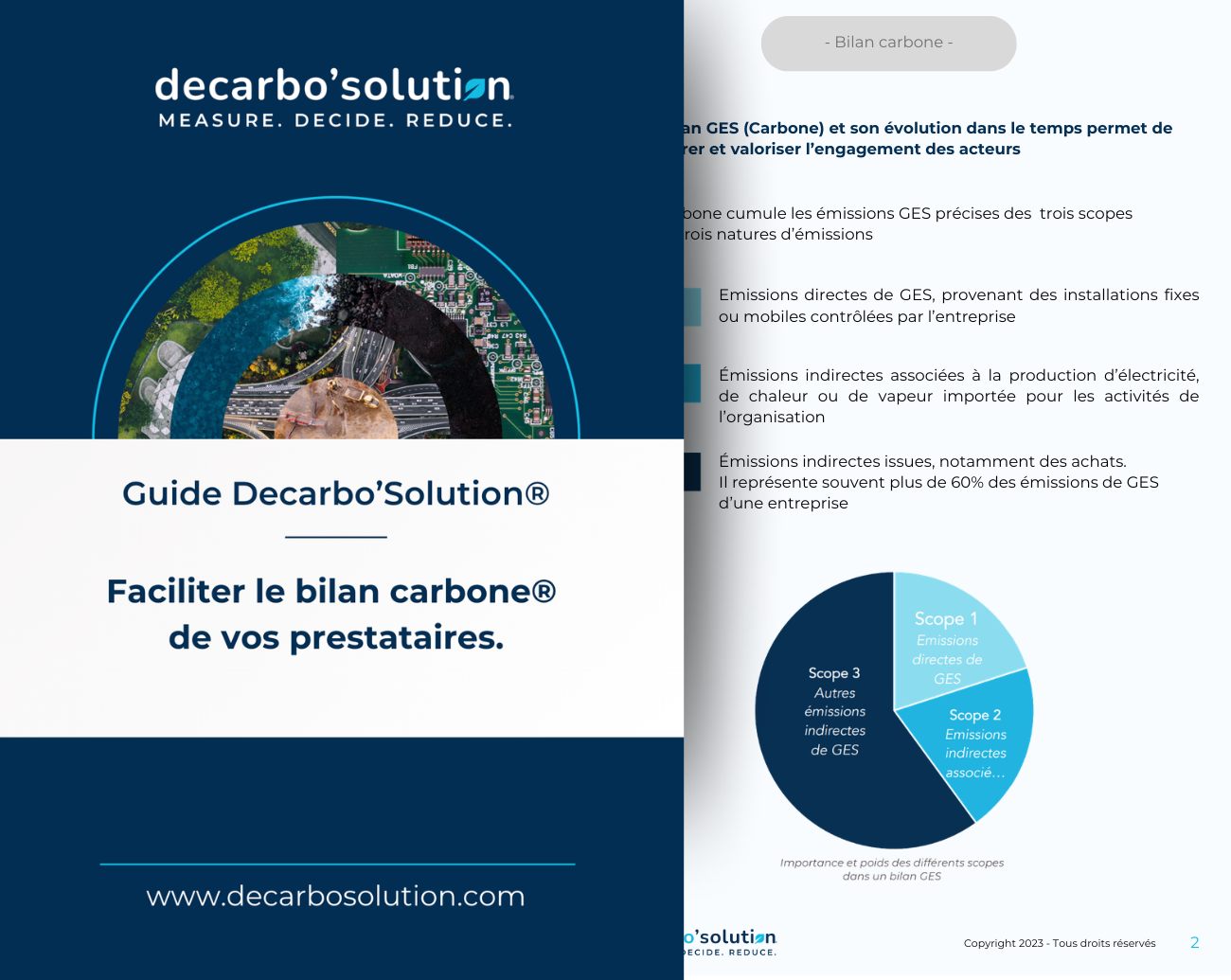
Facilitate the GHG assessment of your providers
Managing and communicating commitments over the long term
Keeping to our climate commitments and proving that we have effectively reduced our emissions requires us to regularly monitor, adjust and communicate our performance. Long-term commitment, year after year, is the key to success.
Dashboards and dynamic indicators are essential for verifying and improving the impact of our actions, and for monitoring the trajectory of our climate objectives in order to come as close as possible to carbon neutrality in the long term. Integrating energy-related issues into these analyses reinforces the relevance of monitoring.
Areas of success :
- Dynamic monitoring of indicators (reduction of greenhouse gas emissions, stakeholder involvement, avoided emissions, constant approach to carbon neutrality), with a stronger link to the principles of decarbonation)
- Reporting in line with regulatory, sector and financial institution requirements, often inspired by Ademe guidelines,
- Training and mobilizing teams around the challenges of sustainable development and adaptation to climate change, as part of a global transition initiative,
- Transparent communication on our strategy, the evolution of our GHG footprint and the progress of our climate objectives.
Action on significant indirect emissions, the valuation of avoided emissions, the possible integration of carbon sinks, and the consideration of long-term adaptation scenarios, demonstrate the level of maturity and sincerity of an ambitious climate strategy.
Decarbo’Solution® propose une gamme d’outils complète (Decarbo’Solution®), des modules d’accompagnement et de sensibilisation (formations, webinaires), des solutions de pilotage interactifs, des rapports détaillés et automatisés.
The deliverables are immediately usable in Transition Plans and CSR reports. They seriously document the company's commitments and trajectory, thus reassuring financial institutions and stakeholders of the reality of the implementation of a sustainable low-carbon trajectory, anchored in a logic of structured and sustainable development.

The 7 advantages of carrying out your company's GHG assessment.
Greenwashing is no longer an option, and putting genuine climate objectives at the heart of corporate strategy is a necessity if we are to contribute to the fight against climate change, while building resilience and credibility with all stakeholders, and ensuring economic sustainability for companies affected by their GHG emissions.
The era of grandiose ambitions and broken promises is over. Today, success depends on transparency, alignment with science, continuous measurement of greenhouse gases, and collective action.
In this demanding context, relying on solutions capable of structuring, securing and managing each stage of the process in complete autonomy becomes a key success factor on the road to zero net emissions.
C’est la force et exclusivité de la Decarbo’Solution® : a comprehensive, tri-modular, 100% compliant approach, designed to support every company - whatever its sector, size or level of maturity - in the reasonable determination and concrete implementation of its climate commitments in relation to its carbon footprint.
From carrying out the initial BEGES, to defining the transition plan, monitoring reduction targets, and mobilizing teams and stakeholders, Decarbo'Solution® offers a suite of reliable, scalable online services that comply with the highest international standards and commitments..
Each action is valorized with the aim of ensuring an effective and sustainable climate strategy, necessary to gradually approach and achieve carbon neutrality.