










Why are regulations reinforcing the importance of carbon footprints?

With the growing importance of regulatory frameworks such as the CSRD, the carbon footprint is becoming a central management tool for companies. Whatever their sector ofactivity, organizations must now precisely quantify their emissions, including indirect ones (Scope 3). In France, theaverage carbon footprint per capita reaches 9.4 tonnes of CO₂ equivalent, 56% of which comes from imported emissions.
The cost of inaction is growing: in 2023, the price of a tonne of carbon on the European market exceeded €100, reinforcing the importance of a planned and measured energy transition. What's more, the cumulative carbon debt of emissions-intensive sectors stands at 644 MtCO₂e in France, underlining the scale of the environmental liability to be reabsorbed.
In this context, the GHG assessment, carried out according to a rigorous method (Bilan Carbone®, ISO 14064), makes it possible to mobilize internal data, raise employee awareness, structure a credible transition plan and align climate strategy with European objectives. Far from being a constraint, regulations become a catalyst for sustainable performance.
Contents
An increasingly demanding regulatory framework for organizations
⚖️ The growing importance of legal obligations
In recent years, European and French legislation has significantly strengthened climate reporting and environmental transparency requirements:
- The CSRD (Corporate Sustainability Reporting Directive) comes into force progressively from 2024. It replaces the NFRD and significantly expands the scope of companies concerned: almost 50,000 companies in Europe will now have to publish structured non-financial reporting, in line with ESRS (European Sustainability Reporting Standards).
This includes the obligation to carry out a complete GHG assessment, covering Scopes 1, 2 and 3, accompanied by a transition plan towards a low-carbon trajectory.
- In France, the decree no. 2022-982 of July 1, 2022 makes the regulatory GHG balance mandatory every 4 years for companies with more than 500 employees. This assessment must include :
- Emissions quantification based on regulatory methodology,
- A justification of reduction actions already implemented,
- And, since 2023, online availability on ADEME's dedicated platform.
These texts reflect a clear determination to make carbon a strategic indicator, managed with the same rigor as a financial balance sheet.
🔦 A broader reporting scope
Historically, regulatory GHG assessments have focused on direct emissions (Scope 1) and emissions linked to energy consumption (Scope 2).
Mapping greenhouse gas emissions
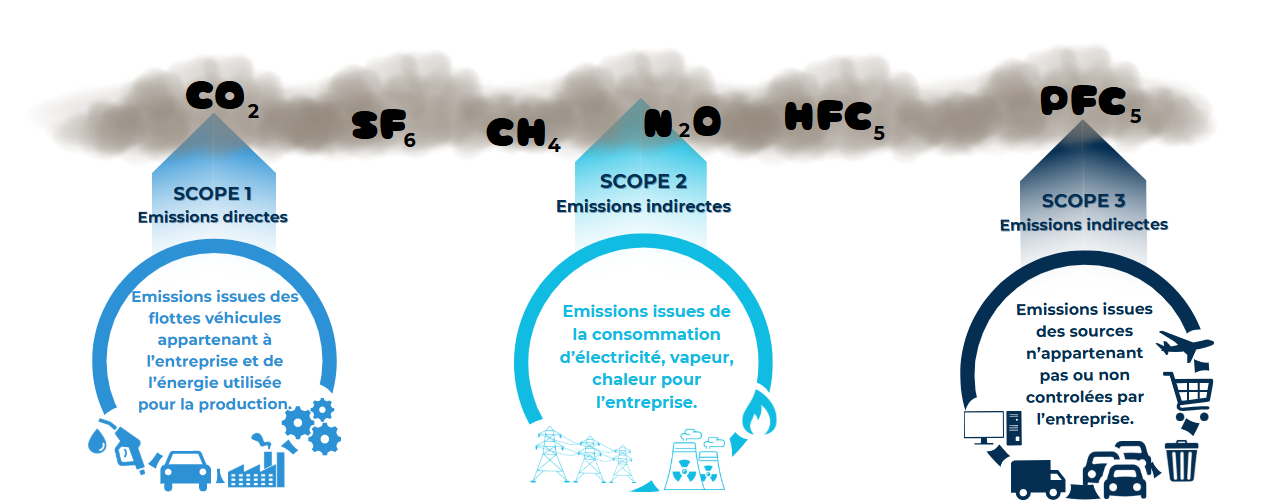
- Scope 1: direct emissions (processes, vehicles, combustion),
- Scope 2: indirect energy-related emissions (electricity, heat),
- Scope 3: other indirect emissions (purchasing, transport, product use, waste, etc.).
Scope 1 and 2 generally represent only 10% to 20% of a GHG balance. Scope 3, on the other hand, is the most significant, accounting for up to 90% of a company's carbon footprint.
The CSRD therefore requires exhaustive consideration of Scope 3, which becomes inseparable from the company's climate performance. This implies mobilizing suppliers, tracing indirect flows, and relying on reliable, verifiable data.
💡The move towards standardized carbon accounting
The increase in regulatory obligations is accompanied by a desire for methodological standardization, to guarantee the comparability, traceability and quality of the climatic data used.
Three reference frameworks have emerged as the pillars of structured carbon accounting:
- The GHG Protocol, used internationally, with its 15 Scope 3 categories;
- ISO 14064, which governs the measurement, verification and reporting of GHG emissions;
- The Bilan Carbone® method developed by theAssociation Bilan Carbone (ABC), widely used in France and aligned with ADEME requirements.
These frameworks enable companies to integrate their carbon data into their management tools, modelemission reduction plans, and bring their climate transition into line with the expectations of regulators, customers, financiers and employees.
Eventually, carbon accounting will become as structuring as financial accounting. Companies will no longer be able to talk about performance without including their GHG footprint.

How to sustain and strengthen your business through a successful low-carbon trajectory.
Increased pressure from customers, investors and partners
In addition to regulatory requirements, companies today are subject to increasing pressure from their ecosystem: customers, principals, investors, business partners, employees and even recruitment candidates. In this context, the carbon footprint is becoming a strategic tool for management, communication and competitiveness.
✅Transparent bidding requirements
More and more public and private sector buyers are incorporating environmental criteria into their selection processes. Responding to a call for tenders now involves providing concrete, verifiable information:
- An up-to-date GHG balance sheet, including Scopes 1, 2 and 3,
- Quantified emissions reduction targets,
- Evidence of concrete actions implemented in the transition plan.
In France, the Climate and Resilience Act (2021) strongly encourages public purchasers to give preference to service providers committed to reducing their carbon footprint. For companies, this means professionalizing their GHG reporting and integrating the carbon issue into their business strategy.
💡 Des outils comme Decarbo’Tender®, développé par Decarbo’Solution®, permettent justement aux organisations de valoriser leur performance environnementale dans les réponses aux marchés, en intégrant des données carbone dès la phase de chiffrage et de rédaction des offres.
❗The carbon footprint as an investment criterion
ESG funds, banks and investors are demanding quantified proof of companies' low-carbon trajectory: reliable reporting, a balance sheet of emissions, and a clear strategy for their reduction.
According to BNP Paribas: "96% of investors surveyed say that CSR issues play a key role in their investment decision-making." Companies with good ESG (Environmental, Social, Governance) performance are particularly valued. Without reliable data, it is impossible to demonstrate the resilience of a business in the face of climate change.
Integrating the carbon footprint into investment criteria thus becomes a strategic lever: it enables the company to prove that it is in control of its climate risks and that its growth is part of a sustainable low-carbon model.
💯 A stronger brand image
Today, expectations in terms of CSR and energy transition come not only from regulators and shareholders. They are also strongly supported by consumers, employees and even future talent.
- Consumers are increasingly aware of thecarbon footprint of the products and services they buy.
- Employees want to work for organizations that are aligned with their environmental values.
- Young talents, especially those from the top business schools, make their career choices conditional on the company's real impact on theenvironment.
In this context, carrying out a complete GHG assessment, accompanied by an ambitious action plan, becomes a strong differentiating factor. It is no longer just an obligation, but a tool for attracting, retaining and mobilizing stakeholders, including employees.
Decarbo’Solution® : votre partenaire pour une stratégie bas carbone réussie
Chez Decarbo’Solution®, nous sommes convaincus qu’aucun plan d’actions ne peut s’opérer sans une compréhension en profondeur des parties prenantes. Decarbo’Solution® propose des formations et un accompagnement sur mesure pour aider les organisations à intégrer la durabilité au cœur de leur stratégie.
To achieve this, we support you at every stage of your environmental transition, through :
👩🎓Une training in climate issues
A course structured into 4 modules:
- Climate and energy fundamentals
- Methodological approach to GHG assessments
- Préparer son Bilan avec Decarbo’Solution®
- Drawing up a balance sheet and reducing emissions
🤝Des ateliers “Fresque du Climat” par Decarbo’Solution®
Our carbon engineers, trained and experienced in running La Fresque du Climat, are available to organize these workshops directly within your company, facilitating your teams' commitment to a concrete climate strategy.
Au-delà de la sensibilisation, Decarbo’Solution® vous accompagne dans la réduction de votre empreinte carbone sur le long terme, grâce aux divers outils disponibles sur notre plateforme.
🎦L’espace Decarbo’Solution® Academy
A place to learn and develop skills:
- Tutorial videos, technical documentation
- FAQ by theme
- Simulations concrètes sur la plateforme Decarbo’Solution®
✨ Customized strategic support
- Complete GHG assessment, including scoping, data collection and reporting
- Our Decarbo'Solutions®, the winning triptych for an effective and sustainable environmental transition:
🛠️Decarbo'Supply®: Decarbonize your purchasing throughout your supply chain. Reduce the carbon footprint of your products through your suppliers.
🎯Decarbo'Target®: Project your GHG balance over time.
⚡Decarbo'Tender®: Integrate carbon performance into your tenders
Pour vous accompagner pour votre Bilan Carbone, confirmité CSRD ou autre, les ingénieurs carbone de Decarbo’Solution®, experts de la méthode Bilan Carbone® et de méthodologies telles que “Act Pas à Pas” de l’ADEME, mettent leur savoir-faire au service de votre organisation, afin de vous guider pas à pas vers une transition environnementale pérenne.
Growing carbon footprint regulations reflect the urgent need for companies to control their carbon footprint and embark on a planned, transparent low-carbon transition. Beyond compliance, rigorous consideration of these issues helps to meet the expectations of customers, investors and partners, while strengthening the competitiveness, innovation and reputation of organizations.
Accompagnées par des acteurs spécialisés comme Decarbo’Solution®, les entreprises disposent aujourd’hui des outils méthodologiques, pédagogiques et stratégiques pour intégrer pleinement leur bilan carbone dans leur gouvernance. Ce passage à une comptabilité carbone standardisée ouvre la voie à une performance durable, responsable et alignée avec les objectifs internationaux de lutte contre le changement climatique.
