










Key steps to building a materiality matrix and turning your challenges into a climate strategy

In a context marked by ecological transition, growing regulatory and fiscal pressure (CSRD, European taxonomy, ISO standards, ETS) and changing stakeholder expectations (customers, employees, investors, suppliers), companies no longer have a choice: they must demonstrate their genuine commitment to sustainable development.
The materiality matrix has become an essential strategic tool. It is not limited to a CSR reporting exercise. CSR reporting or mapping environmental issues. When well constructed, it forms the basis of an ambitious climate policy, enabling:
- Prioritize priorities.
- Improve environmental performance.
- Guide the organization's sustainable management.
This article details the three key steps to creating a successful materiality matrix:
- Understanding its strategic value.
- Identify key issues methodically.
- Translate this analysis into a concrete action plan using innovative solutions such as Decarbo’Solution®.
Contents
Understanding what a materiality matrix (really) is
Definition and strategic role
A materiality matrix is a management tool that combines two dimensions:
- What is important to stakeholders (customers, employees, supply chain partners, investors, communities).
- Which has a real impact on the company's activities (environment, finances, ethics, safety, working practices).
It provides a diagrammatic overview of the key issues that should guide climate strategy, CSR policy, and governance practices.
More than just CSR reporting
Too often reduced to a compliance exercise, the materiality matrix is in fact a strategic management tool that:
- helps anticipate ESG (environmental, social, and governance) risks.
- is a lever for sustainable competitiveness.
- creates sharedCSR communication between management, employees, and stakeholders.
Chez Decarbo’Solution®, la matrice de matérialité est considérée comme une étape fondamentale avant toute démarche climat, car elle donne du sens au plan d’action et aligne les valeurs de l’entreprise avec ses engagements.

How to sustain and strengthen your business through a successful low-carbon trajectory.
Identify priority issues methodically
A rigorous evaluation phase
The success of a matrix depends on structured and inclusive work. The most effective methods include:
- Internal consultations: workshops, employee surveys.
- External dialogue: discussions with customers, investors, strategic suppliers, NGOs.
- Documentary and regulatory review: ESG compliance, ISO 26000 standards, CSRD.
- Risk mapping: ecological, social, ethical, and financial impacts.
Identify what is essential and avoid what is superfluous
This phase allows us to distinguish between truly fundamental issues and secondary topics:
- Examples of key topics: climate, emissions, security, diversity, energy transition, responsibility.
Each identified issue is assessed according to:
- Its importance for stakeholders.
- Its potential impact on the company's business, results, and governance.
L’accompagnement expert de Decarbo’Solution®
Les équipes Decarbo’Solution® accompagnent les groupes et entreprises grâce à :
- Proven study tools.
- An expert reading of international standards.
- Participatory methods that facilitate employee buy-in and stakeholder engagement.
This approach guarantees a robust matrix, useful not only for compliance with standards but above all for sustainable management and decision-making.
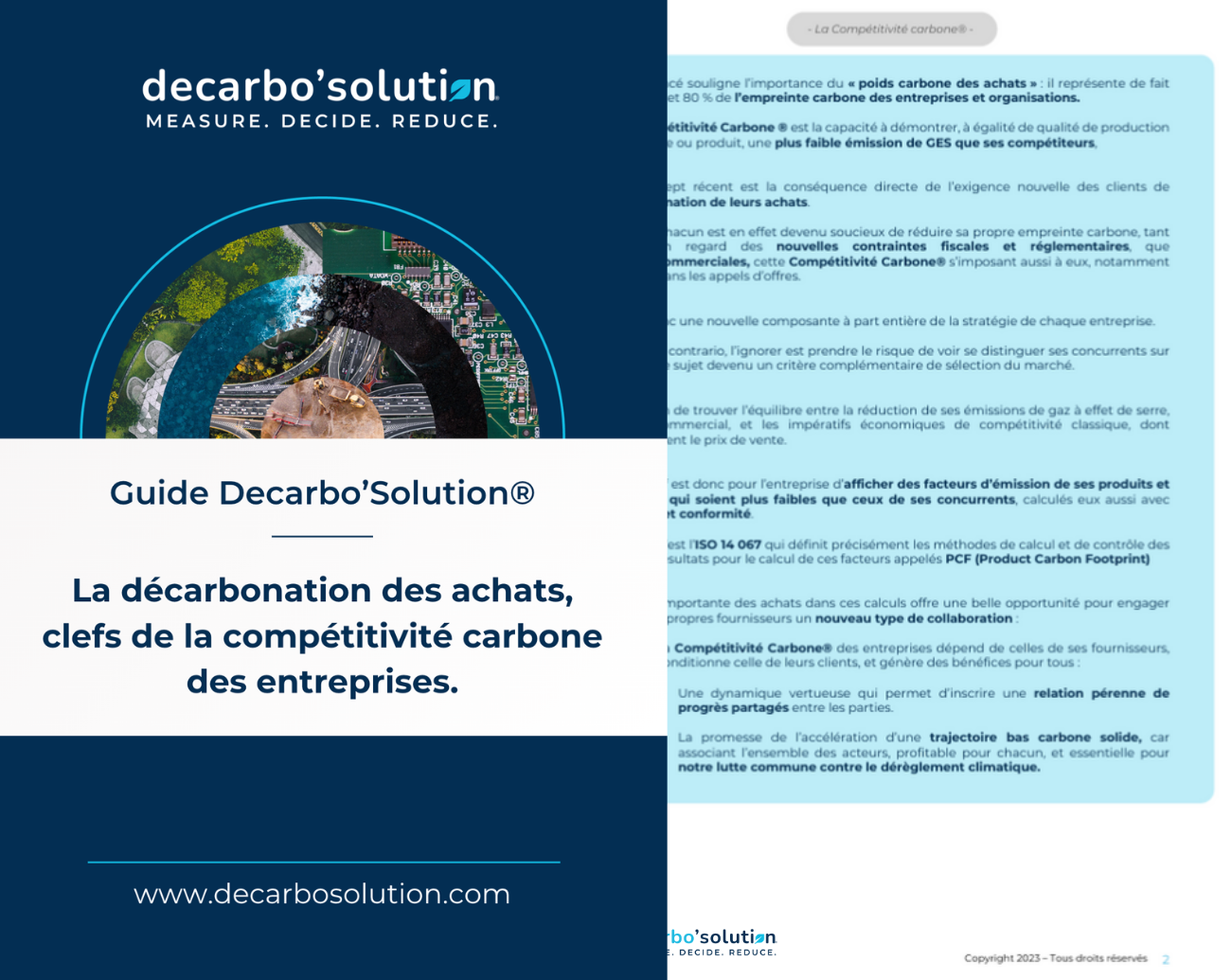
Decarbonization of purchasing, the key to corporate carbon competitiveness.
Translate the matrix into a climate action plan
From analysis to action
A materiality matrix is only valuable if it translates into concrete actions. Companies must:
- Prioritize the most significant emission sources.
- Implement corrective and innovative measures.
- Mobilize all stakeholders, including strategic partners.
Decarbo’Solution® modules: transforming analysis into results
Pour accompagner les organisations dans ce passage à l’action, Decarbo’Solution® a développé la suite Decarbo’Solution® :
- Decarbo’Target®: create, simulate, and manage a multi-year action plan. Visualize the impact of each action and define an ambitious trajectory.
- Decarbo’Supply®: targeting reductions in procurement weight, which can account for up to 80% of a company's Scope 3 emissions. Promoting carbon positive discrimination® and strengthening competitiveness.
Decarbo’Tender®: integrate environmental criteria into calls for tenders, in accordance with ISO 14067 and public procurement regulations. Select more responsible partners and improve overall results.
Towards a low-carbon trajectory
By combining the materiality matrix and Decarbo’Solution® tools, companies can:
- Comply with reporting and compliance requirements (CSRD, ISO, SBTi).
- Strengthen their competitiveness in the market.
- Bringing together employees, partners, and customers in a dynamic process of sustainable value creation.
The matrix thus becomes the first step in an ambitious climate initiative, integrated into management and aligned with performance objectives.

In summary, building a materiality matrix means investing in a more responsible, competitive, and sustainable future.
Avec l’accompagnement de Decarbo’Solution® et sa suite Decarbo’Solution®, les entreprises passent d’un simple schéma des enjeux à une trajectoire bas-carbone ambitieuse et pilotable, conforme aux réglementations, créatrice de valeur et porteuse d’impact positif pour l’environnement et la société.
In summary, building a materiality matrix means investing in a more responsible, competitive, and sustainable future.