










Carbon neutrality 2050: challenges, strategies and levers for a successful green transition

At both national and internationallevel, carbon has become the main source of GHG emissions. Achieving carbon neutrality - the Net Zero Initiative - is an essential objective for preserving our climate, as the experts on the EuropeanUnion 's climate council have pointed out.
In this global context, and in line with the ParisAgreement, France can capitalize on its natural assets to act as a carbon sink. Our country has unique assets: its forests, which are true allies in the sequestration of emissionson a nationalscale.
Every economic sector is now concerned by this climate objective. Businesses, in particular, have a key role to play, as low-carbon strategy consultancies regularly remind us. Their mission: to deploy innovative solutions compatible with the commitments of the EuropeanUnion and the Paris Agreement.
C’est dans cette dynamique que Decarbo’Solution® (Decarbo’Solution®) accompagne les acteurs publics et privés à travers le pays et au-delà, en leur fournissant les outils nécessaires pour aligner performance économique et réduction des émissions à toutes les échelles d’action.
1. Issues and challenges of carbon neutrality by 2050
1.1 Climate emergency and regulatory framework
1.3 Carbon calculation complexity
2. Stratégies et leviers opérationnels pour une transition réussie
3. La solution intégrée Decarbo’Solution® : plateforme SaaS & accompagnement expert
3.1 Decarbo'Solution®, the winning triptych for a successful environmental transition
Issues and challenges of carbon neutrality by 2050
The Net Zero Initiative is an ambitious and unavoidable objective for limiting global warming to +1.5°C, in line with the IPCC's warnings. This transition to a low-carbon economy requires the implementation of concrete measures to reduce emissions. This includes the integration of renewable energies.
🌡️Urgence climate and regulatory framework
Against this backdrop, European standards play a structuring role in framing the actions of organizations and directing investments towards sustainable activities. Companies must therefore rethink their business models in depth, in order to combine performance, regulatory compliance and environmental responsibility.
- CSRD (Corporate Sustainability Reporting Directive) requires large European companies to publish detailed non-financial data from 2024.
- European Taxonomy guides investments towards eligible activities, assessing their contribution to carbon neutrality.
- Science Based Targets initiative (SBTi) provides a framework for defining reduction targets in line with the 1.5°C trajectory.
- The Stratégie Nationale Bas Carbone (SNBC) is France's roadmap for combating climate change. It aims to achieve carbon neutrality by 2050.
👉In France, Law no. 2019-1147 of November 8, 2019 on energy and climate, part of the implementation of the SNBC, strengthens companies' obligations to publish GHG balances. It provides for financial penalties for non-compliance, in particular for companies subject to the obligation to carry out and publish this assessment.
These obligations oblige each organization to structure a rigorous carbon strategy, integrated into its governance, in order to actively contribute to the fight against global warming.
Failure to do so could result in financial penalties, a loss of stakeholder confidence and a negative impact on the company's reputation. Indeed, reducing greenhouse gas emissions has become as much a strategic imperative as an environmental one.
⚡️Risques and opportunities
The low-carbon transition is far from being a mere cost: it's a real lever for competitiveness and resilience:
- Access to green financing: Green bonds, sustainable loans and subsidies are multiplying to support virtuous projects that are part of a sustainable development approach.
- Reputation and attractiveness: committed companies attract talent, investors and customers concerned about social impact.
- Innovation and new markets: eco-products, circular services and low-carbon solutions create added value and reinforce differentiation, while anticipating future regulations. (SNBC, carbon tax, CSRD omnibus)
Conversely, inaction exposes us to the risk of regulatory penalties, higher energy costs and disinvestment by financial players.
🔦Complexity of carbon calculation
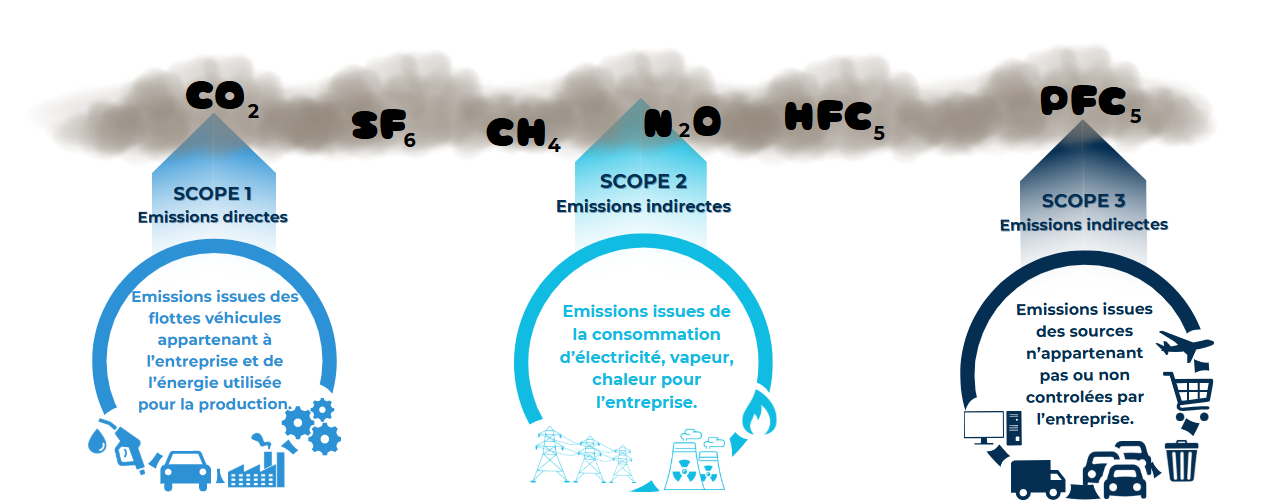
For effective management, we need to cover all atmospheric greenhouse gas emissions, broken down into scopes 1, 2 and 3:

The 7 advantages of carrying out your company's GHG assessment.
Scope 1: direct emissions from stationary and mobile sources controlled by the company (combustion, processes).
Scope 2: indirect emissions linked to the production of imported electricity, heat and steam.
Scope 3: other indirect emissions in the value chain (purchasing, transport, product use and end-of-life).
Collecting and consolidating data from multiple systems (ERP, statements, suppliers) and modeling emissions scenarios without automation or standardization leads to incomplete or even erroneous assessments. However, reliable data is the sine qua non for establishing a credible and consistent roadmap.
Strategies and operational levers for a successful transition
To participate in the transition to carbon neutrality, every company needs to put in place a structured plan. This combines ambitious strategies with concrete measures to reduce emissions.
Here are the main operational levers to be activated to anchor this transition in the daily reality of organizations:
1️⃣Cartographier and prioritize
- Confidential carbon audit: carry out an initial assessment to identify emissions hotspots and measure the current footprint.
- SMART objectives: formulate specific, measurable, attainable, realistic and time-bound targets
2️⃣Optimiser energy efficiency
- Performance audits: assess the energy consumption of buildings, industrial processes and data centers.
- Investments in high performance: heat pumps, LED lighting, variable speed drives on motors to drastically reduce consumption.
3️⃣Éco-design and responsible purchasing
- Low-carbon design: integrating life-cycle analysis right from the R&D phase.
- Sustainable purchasing: give preference to certified suppliers (ISO 14001, low-carbon labels) and recycled or bio-based materials.
4️⃣ Carbon-free mobility and logistics
- Company mobility plan: deploy electric fleets, encourage carpooling and telecommuting.
- Optimizing flows: pooling transport, optimized routing, use of alternative modes (rail, river).
5️⃣Gouvernance and commitment
- Low-carbon referents: appoint a pilot for each business unit to coordinate the approach.
- Awareness-raising: ongoing training programs and workshops to co-construct reductions in greenhouse gas emissions.
6️⃣Financement green and support mechanisms
- Green bonds and subsidies: benefit from financing backed by low-carbon criteria.
- Climate-related financial KPIs: integrate carbon performance into variable compensation and management reporting.
7️⃣ Transition to renewable energies
- Energy substitution: replacing fossil fuels with renewable sources (solar, wind, biomass, geothermal) adapted to the company's needs.
- Self-generation and self-consumption: installation of photovoltaic panels, micro-wind turbines or biomass boilers to produce a growing share of the energy consumed locally.
- Green electricity purchases: subscribe to certified renewable energy contracts to reduce our indirect carbon footprint (Scope 2).
- Energy partnerships: cooperating with local players to develop joint projects to produce or share renewable energy.
These actions must be part of a coherent framework, documented in a sustainability report and compliant with regulatory requirements. These are no longer simply isolated initiatives, but a global transformation, guided by a long-term vision and supported by all our businesses.

How to sustain and strengthen your business through a successful low-carbon trajectory.
La solution intégrée Decarbo’Solution® : plateforme SaaS & accompagnement expert
Decarbo’Solution® propose des formations et outils sur-mesure pour aider chaque organisation à suivre l’évolution de ses émissions de gaz à effet de serre, établir un bilan GES solide et élaborer des actions afin de réduire leur empreinte carbone.
The aim is to support companies in their ecological transition, while improving their long-term competitiveness.
Pour accompagner les entreprises dans cette transition, les ingénieurs carbone de Decarbo’Solution®, experts de la méthode Bilan Carbone® (niveau 2, ABC) et de méthodologies telles que “Act Pas à Pas” de l’ADEME, mettent leur savoir-faire au service de chaque organisation, afin de les guider pas à pas vers une durabilité concrète et adaptée.

💡Decarbo'Solution®, the winning triptych for a successful environmental transition
Faced with the complexity of regulatory requirements and the need to ensure the reliability of carbon data, Decarbo'Solution® offers an integrated approach, structured around three complementary modules to accelerate and control the low-carbon transition:
✅ Decarbo'supply®
- Accurate, automated Scope 3 calculations, regardless of the Bilan Carbone® tool used.
- Development of a data-driven decarbonization roadmap.
- Proactive involvement of suppliers in reducing emissions.
- Implementation of positive carbon discrimination® to favor suppliers with the lowest emissions.
🎯 Decarbo'Target®
- Design and management of comprehensive action plans, based on ADEME's ACT method.
- Quantification and projection of GHG impact using intelligent simulation tools.
- Definition of a low-carbon trajectory, co-constructed with stakeholders.
- Ongoing comparison of actual trajectory with reduction targets validated by SBTi.
📑 Decarbo'tender®
- Systematic request for PCF or FEMPP® in calls for tender.
- Intégration directe avec la plateforme Decarbo’Solution® pour un calcul par bien ou service accompagné d’une notice descriptive.
- Full compliance with the French Public Procurement Code, via a targeted environmental feature.
- Strict compliance with ISO 14 067 standards, ensuring data robustness and transparency.
💚Human support from our carbon engineers
Consciente de l’importance de sensibiliser les salariés aux enjeux environnementaux, Decarbo’Solution® propose des formations et un accompagnement sur mesure pour aider les entreprises à intégrer la durabilité au cœur de leur stratégie.
- Customized training
➡️ Training to raise awareness of energy and climate issues
This training program, made up of several modules, helps to integrate sustainable practices into the corporate culture, while educating employees about the effects of climate change and the sustainable development strategies to adopt.
→ Module 1 - Climate and energy fundamentals
→ Module 2 - Methodological approach to GHG inventory
→ Module 3 – Préparer son Bilan GES avec Decarbo’Solution®
→ Module 4 - Drawing up a GHG inventory and reducing GHG emissions.
➡️ La Fresque du Climat par Decarbo’Solution® : Comprendre les enjeux et impacts globaux liés au réchauffement climatique
The Climate Fresco is a flagship workshop that helps employees understand the causes and consequences of climate change. By making scientific knowledge accessible and encouraging dialogue, this workshop stimulates collective environmental awareness.
💡This collective intelligence workshop enables participants to reconstruct the cause-and-effect links of these changes and explore the actions to be taken on both a personal and professional level.
Our carbon engineers, trained and experienced in running the Fresque du Climat, are available to organize these workshops directly within companies, facilitating the commitment of teams to a concrete environmental transition.
- Audits & ongoing coaching
- Customized diagnostics to prioritize action levers
- Step-by-step mentoring to deploy and monitor the low-carbon roadmap
- Communauté Decarbo’Solution®
- Themed webinars, feedback and exclusive case studies
- A network of companies committed to sharing best practices and innovations
Grâce à cette combinaison unique de technologie avancée et d’expertise humaine, Decarbo’Solution® vous fournit les outils et l’accompagnement nécessaires pour participer aux objectifs de neutralité carbone 2050 avec confiance et efficacité.
On a global scale, the fight against greenhouse gas emissions is one of the greatest challenges of our time. Successive IPCC reports have highlighted the urgent need for a collective effort by all countries to achieve carbon neutrality by 2050.
Ce cap exige une transformation profonde des modèles économiques, mais ouvre aussi la voie à de nouvelles opportunités pour les entreprises qui sauront agir avec anticipation. En s’appuyant sur une stratégie climat rigoureuse, des leviers opérationnels adaptés et des outils comme la solution intégrée de Decarbo’Solution®, les organisations peuvent répondre aux exigences réglementaires tout en affirmant leur rôle dans une transition juste et durable.
Carbon neutrality must no longer be a distant ideal, but a concrete ambition, achieved today at every level - local, national and global.

Gaëtan COUREUL | Amaury Sport Organisation
A.S.O choisit Decarbo’Solution® pour évaluer l’empreinte carbone de ses événements, en commençant par celui du Tour de France.

Benjamin GRIZBEC | French Badminton Federation
La FFBad confie à Decarbo’Solution® l’évaluation carbone de ses activités, et se poursuit avec la réalisation du bilan GES de 20 clubs affiliés.

Christophe CHRISTEN | SCHMIDT Groupe
The Schmidt Group was able to enrol 80% of its suppliers (in terms of financial volume), and save 242 tonnes of CO2.